
Anúncios
Introduction to the Future of Education in 2050
As we advance further into the 21st century, the rapid pace of technological change prompts us to imagine what the future holds. By 2050, the way we teach and learn will likely be transformed beyond recognition. The traditional classroom setting has already begun to evolve with the advent of digital tools, but the coming decades promise even more radical changes. In this imagined future, education will be an interconnected tapestry of artificial intelligence, cloud-based platforms, and immersive technologies that transcend today’s limitations. This revolution in learning will not only redefine accessibility but also enhance the quality and personalization of education worldwide.
As we look to 2050, it becomes imperative to consider the myriad of technological innovations and methodologies that will drive this transformation. One of the most significant developments will be AI teachers—digital facilitators that can adapt to each student’s learning style and pace. This evolution raises important questions about the role of human educators and the implications of a technology-driven educational framework. Beyond AI, advances in virtual and augmented reality, personalized learning, and global cloud-based systems will create a mosaic of opportunities and challenges that educators, policymakers, and students must navigate together.
Anúncios
The Role of AI Teachers in Transforming Classrooms
AI teachers, envisioned as highly sophisticated machine-learning-based educators, will revolutionize the educational landscape. These computer systems, equipped with deep learning algorithms, will be capable of doing much more than just delivering pre-set lessons. They will possess the ability to assess the unique learning styles, strengths, and weaknesses of each student, tailor educational experiences accordingly, and provide immediate feedback.
The benefits of AI teachers are numerous. They offer personalized and adaptive learning experiences that can cater to individual student needs, ensuring no learner is left behind. This personalized attention can significantly enhance student engagement and motivation, thanks to adaptable curriculums that meet each learner’s pace and interests. Moreover, AI teachers can process data at incredible speeds, providing educators with insights into student progress and potential areas for improvement, thus fostering a more data-driven approach to education.
However, alongside these benefits comes a set of challenges. Reliance on AI-driven instruction may lead to concerns about the standardization of education, the potential loss of the critical human element in teaching, and ethical issues regarding data privacy. To address these challenges, educators and developers must work collaboratively to ensure AI teachers complement—rather than replace—human educators, preserving the invaluable human connection in learning.
How Cloud-Based Learning Will Redefine Accessibility
Cloud-based learning environments represent a pivotal shift in how education is accessed and delivered. By storing educational content and resources in the cloud, schools can provide students everywhere access to the same learning materials, regardless of geographical or economic barriers. This opens up educational opportunities to millions who might otherwise be deprived of quality education due to their location or socio-economic status.
The accessibility afforded by cloud-based learning has several key advantages. First, it democratizes education by bridging the gap between urban and rural learners, offering a level playing field. Second, it enables on-demand learning, allowing students to access resources whenever necessary, fostering self-directed learning habits. Cloud platforms facilitate collaboration across borders, enabling students from different parts of the world to work together on projects, exchange ideas, and engage in cultural exchanges, thus promoting a more globalized educational experience.
However, the shift to cloud-based education is not without obstacles. Challenges include ensuring data security, providing stable internet connections in underdeveloped regions, and addressing the digital divide that still exists in many parts of the world. As schools and governments work towards enhancing internet infrastructure and implementing robust cybersecurity measures, the transformative potential of cloud-driven education becomes increasingly achievable.
The Impact of Technology on Traditional Teaching Methods
The integration of technology in education has shifted traditional teaching approaches, prompting educators to reevaluate methodologies that have been in place for centuries. In many ways, technology has enhanced teaching and learning, offering dynamic new tools that support interactive lessons, enhance visual learning, and facilitate collaborative projects.
One of the most notable impacts is the shift from rote memorization to critical thinking and problem-solving. With access to information just a click away, teachers are focusing more on teaching students how to analyze data, draw conclusions, and apply knowledge in practical situations. Tools like interactive whiteboards, online simulations, and digital labs form a new pedagogical paradigm that prioritizes experiential learning.
However, these advancements also present certain challenges. The increasing reliance on technology poses a risk of diminishing traditional skills such as handwriting and face-to-face communication. There is also the ubiquitous challenge of maintaining student attention amidst digital distractions. To counter this, educators must find a balance, integrating technology in a way that complements traditional methods while fostering an environment conducive to all forms of learning.
Benefits and Challenges of AI-Driven Education
AI-driven education carries with it profound benefits, promising a more personalized and efficient learning process for students worldwide. AI systems can analyze vast amounts of data to identify trends and patterns in student behavior, enabling educators to tailor learning paths that optimize student engagement and success.
Some key benefits include:
- Personalization: Custom lesson plans that adapt to each student’s learning style and pace.
- Efficiency: Automated grading and assessments provide immediate feedback, reducing teacher workload.
- Accessibility: AI-driven tools can cater to special education needs, translating materials into accessible formats.
Despite these benefits, several challenges need to be addressed. Chief among them is the concern of over-reliance on AI, which could undermine the human elements critical to personal development. Additionally, there are ethical considerations surrounding data privacy and the use of AI algorithms in decision-making processes. To navigate these challenges, stakeholders must work towards transparent AI systems that value human oversight and ethical standards, ensuring these powerful tools are harnessed responsibly and equitably.
Addressing Concerns About AI Replacing Human Teachers
The rise of AI in education inevitably sparks concerns about the potential replacement of human educators. While AI teachers offer many benefits, it is imperative to recognize the irreplaceable qualities that human educators bring to the classroom—empathy, intuition, and the ability to inspire.
Human teachers play a critical role in fostering a supportive learning environment. They form emotional connections and understand the nuanced needs of each student, offering mentorship that goes beyond academic instruction. These educators are vital in nurturing social development, critical thinking, and creativity, skills that are difficult for AI to replicate.
Therefore, the conversation should focus on how AI can augment rather than replace human teachers. By taking over routine tasks such as grading and data tracking, AI can free up teachers to focus more on individualized instruction and mentorship. Developing a synergistic relationship between AI and human educators will be key to maximizing the benefits of both, ensuring that education remains a profoundly human-centric endeavor.
The Role of Virtual and Augmented Reality in 2050 Education
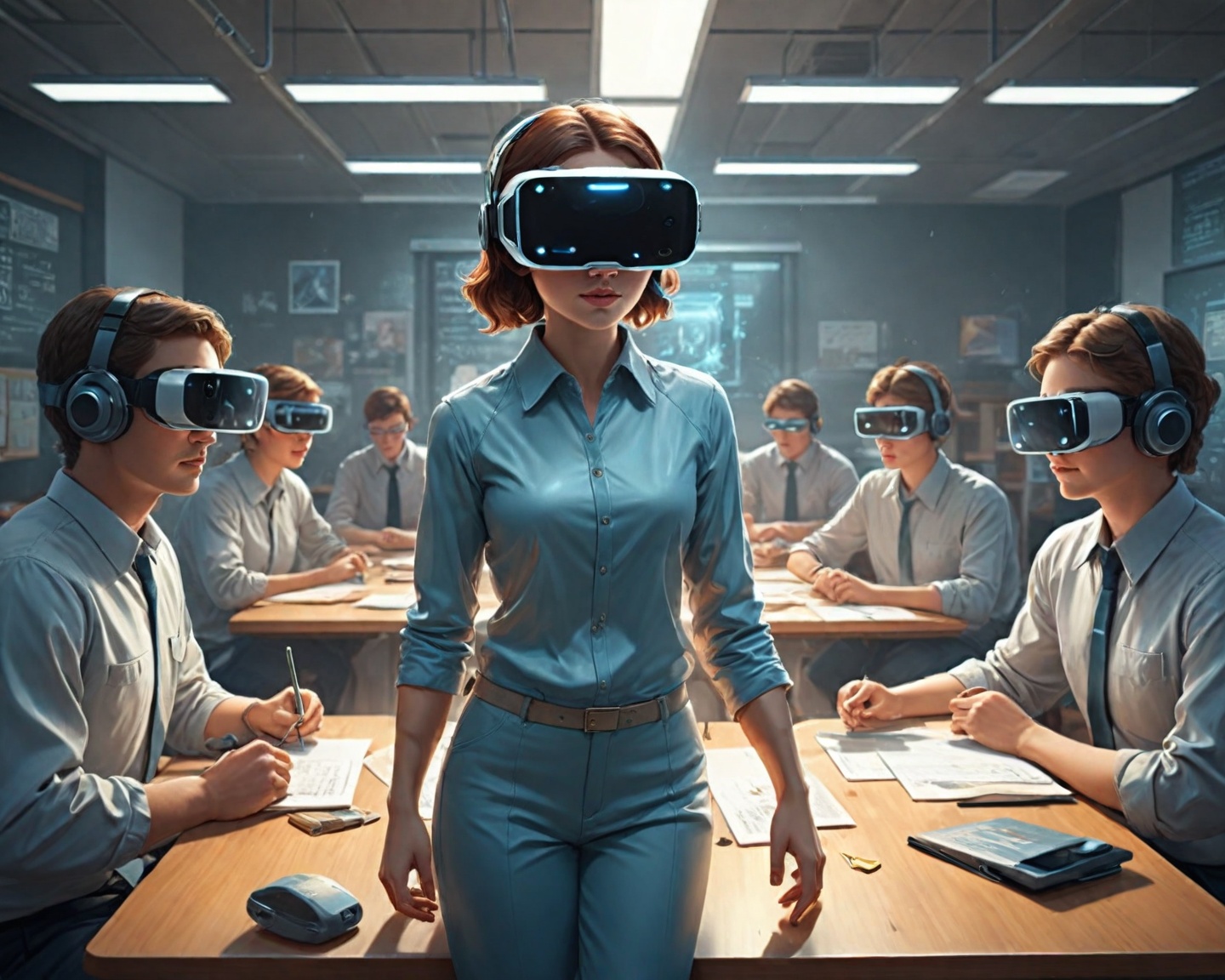
The integration of virtual reality (VR) and augmented reality (AR) will transform education by creating immersive learning experiences that engage students and bring subjects to life. In 2050, these technologies will be ubiquous in classrooms, enabling learners to explore new environments and concepts in ways previously unimaginable.
VR and AR will allow students to experience historical events, explore foreign cultures, or even conduct complex scientific experiments without the constraints of time and space. Such interactions will enhance comprehension and retention by allowing students to “experience” learning rather than passively receiving information.
Additionally, students with different learning preferences can benefit immensely, as these technologies accommodate visual, auditory, and kinesthetic learners alike.
However, the integration of VR and AR presents challenges as well. Ensuring equitable access to these technologies, addressing potential health issues related to their use, and developing curriculum that effectively integrates them will require careful planning and investment. As educators and technologists collaborate to overcome these obstacles, the potential of VR and AR to enrich education becomes ever more promising.
How Personalized Learning Will Evolve with AI
AI will be a driving force in the evolution of personalized learning, enabling a tailored educational approach that recognizes each student’s unique needs and learning styles. By 2050, AI systems will have advanced to provide an unprecedented level of customization, offering students a learning experience that is truly individualized.
Education platforms driven by AI will constantly assess a student’s progress, interests, and challenges, adapting content accordingly to keep them engaged and motivated. This dynamic personalization will allow students to advance at their own pace, ensuring a more thorough understanding of subject matter and reducing the stress associated with traditional pacing.
Factors such as cultural background, special needs, and personal interests will all be considered as AI algorithms continue to improve in sophistication. Integrating AI in this way will not only support cognitive development but also promote a lifelong love of learning, encouraging students to become self-driven and explorative learners who are well-prepared for the dynamic world ahead.
Global Implications of Cloud-Based Education Systems
The widespread adoption of cloud-based education systems will have significant global implications, promoting educational equity and reshaping the way knowledge is disseminated across the globe. By breaking down barriers related to access and cost, cloud platforms could support widespread distribution and democratization of education.
Cloud-based systems enable collaboration beyond borders, allowing students from diverse backgrounds to share knowledge and tackle global challenges collaboratively. These global interactions will encourage cross-cultural understanding and prepare students to thrive in an interconnected world, where complex issues often require diverse perspectives.
| Advantages | Challenges | Solutions |
|---|---|---|
| Greater access to educational resources | Digital divide between regions with differing internet access | Improving global internet infrastructure |
| Enhanced global collaboration | Security and privacy of student data | Robust cybersecurity measures and policies |
| Cost-effective education delivery | Ensuring educational quality and consistency | Developing global educational standards and practices |
However, these opportunities come with challenges such as managing data security on a global scale and addressing the digital divide still prevalent in many areas. Continued investment in technological infrastructure and policymaking will be critical in ensuring that cloud-based education systems contribute positively to global human development.
Practical Steps for Schools to Prepare for 2050
Preparing for the educational demands of 2050 requires strategic thought and proactive measures by schools and educational institutions today. Schools must begin embracing innovative teaching strategies and technological infrastructure to ensure they are not left behind in this rapidly evolving landscape.
Firstly, investing in teacher training programs focused on technology and digital literacy is essential. Educators need to be equipped with the skills to integrate AI, VR, AR, and cloud-based platforms effectively in their teaching. This training should emphasize the complementary nature of these technologies and traditional teaching methods.
Secondly, establishing a robust digital infrastructure is crucial for seamless integration of technology into the classroom. This includes high-speed internet access, secure cloud services, and devices that support interactive and personalized learning environments.
Lastly, fostering partnerships with tech companies and educational organizations will enable schools to remain at the forefront of technological advancements. These partnerships can provide access to cutting-edge tools, resources, and insights that can be instrumental in shaping a future-ready education system.
Frequently Asked Questions
What are AI teachers and how do they work?
AI teachers are intelligent systems designed to facilitate learning by analyzing student data and providing personalized educational experiences. Utilizing machine learning algorithms, they adapt lessons to fit the cognitive and emotional needs of each student, enhancing engagement and understanding.
Can AI teachers replace human teachers?
AI teachers are not intended to replace human educators but to assist them. By taking over administrative and routine tasks, AI allows human teachers to focus more on providing mentorship and addressing the social and emotional aspects of learning that AI cannot replicate.
How will cloud-based learning make education more accessible?
Cloud-based learning democratizes education by allowing access to resources online, breaking down geographical and socio-economic barriers. Students can learn from anywhere with an internet connection, enabling a more inclusive educational environment.
What role will AR and VR play in future classrooms?
AR and VR will provide immersive learning experiences that make abstract concepts tangible. They help students explore environments and scenarios that would be impossible in a traditional classroom setting, enhancing understanding and retention.
What are the potential drawbacks of incorporating AI in education?
Challenges include concerns about data privacy, the potential for over-reliance on AI systems, and the risk of reducing human interaction in education. Ensuring a balance between technology use and face-to-face interaction will be vital.
Is cloud-based education secure?
While cloud-based education can be secure, it requires robust cybersecurity measures. Proper encryption, user authentication, and regular audits are necessary to protect student data and privacy.
Will personalized learning replace traditional curriculums?
Personalized learning will likely complement rather than replace traditional curriculums. By tailoring lessons to individual strengths and weaknesses, personalized learning aims to enhance the traditional educational framework rather than dismantle it.
How can schools start preparing for the technological changes expected by 2050?
Schools can prepare by investing in teacher training, establishing strong digital infrastructure, and forming partnerships with technology providers to gain access to the latest educational tools and resources.
Recap
The landscape of education is poised for dramatic transformation by 2050, with AI teachers, cloud-based learning, and immersive technologies reshaping how and where students learn. AI will play a pivotal role in providing personalized education, acting as both an assistant and an enhancer to human educators. Cloud-based platforms will democratize learning, offering global classrooms devoid of physical barriers. Despite concerns about data security and the human element in education, the potential for a richer, more equitable learning environment is evident. Practical steps involving investment in training, infrastructure, and partnerships are essential for schools to adapt to these impending changes.
Conclusion
Education in 2050 will be a synergy of human intuition and technological innovation. As we stand on the cusp of this new era, it becomes crucial to acknowledge the diverse challenges and opportunities that lie ahead. Educators, policymakers, and technologists must collaboratively ensure that this transformation benefits every learner and nurtures not only academic achievement but also empathy, creativity, and critical thought.
The future of schooling is not a distant idea but an imminent reality. By embracing the potential of AI, cloud-based learning, and immersive technology today, we set the foundation for an education system that is inclusive, dynamic, and prepared to educate future generations in ways this world has yet to see.