
Anúncios
Introduction to Saturn: A Brief Overview
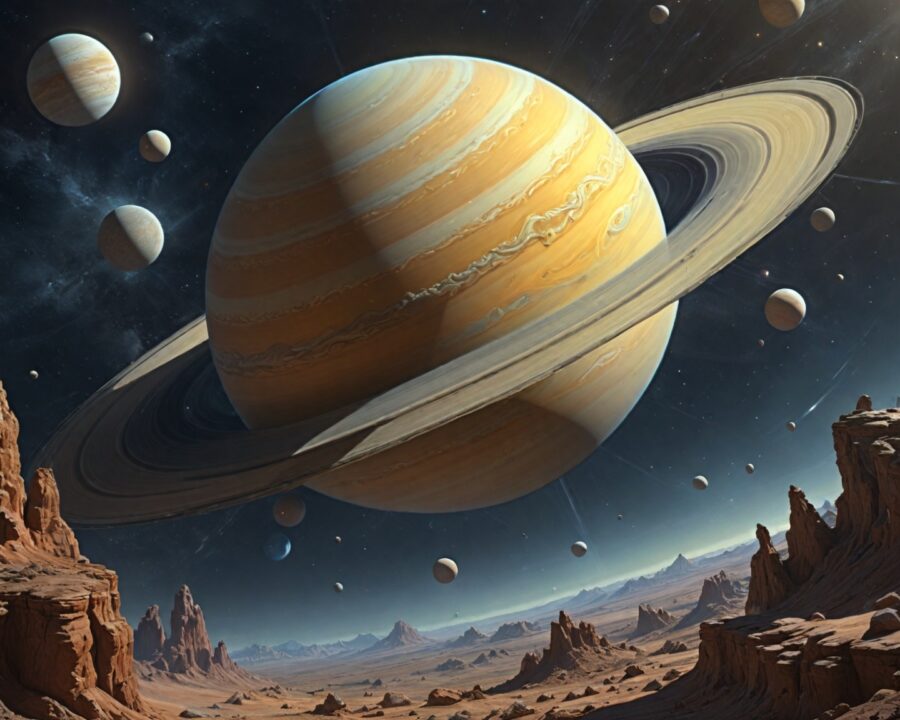
Saturn, the sixth planet from the Sun, stands out as one of the most intriguing celestial bodies in our solar system. Known for its stunningly beautiful ring system, this gas giant captivates the imaginations of astronomers and laypeople alike. As the second-largest planet in our solar system, Saturn’s composition, atmosphere, and unique characteristics provide a wealth of information for scientists seeking to understand more about the formation and evolution of planetary bodies.
Characterized by its pale yellow hue and expansive ring system, Saturn is composed predominantly of hydrogen and helium, much like its neighbor Jupiter. Despite its massive size, Saturn’s density is so low that it would float in water, assuming an ocean large enough to hold it existed. The exploration of Saturn and its complex array of moons and rings not only sheds light on Saturn itself but also offers insights into the dynamics of planetary systems as a whole, providing a broader understanding of the universe and our place within it.
Anúncios
The Composition and Structure of Saturn’s Rings
Saturn’s rings are one of the most remarkable features of our solar system, extending up to 175,000 miles from the planet but with an average thickness of just 30 feet. These rings are primarily composed of countless small particles, ranging in size from microscopic grains of ice to chunks as large as a small vehicle, each orbiting the planet independently. Water ice makes up roughly 90 to 95 percent of the rings’ composition, with small amounts of rocky material and dust.
The intricacy of Saturn’s rings lies in their division into multiple main sections named alphabetically in the order of their discovery: A, B, C, D, E, F, and G rings. The A and B rings are the most prominent, separated by a gap known as the Cassini Division, a region spanning about 2,920 miles. It is these divisions and gaps, often maintained by the gravitational influence of Saturn’s moons, that highlight the dynamic and complex nature of the ring system.
Recent studies have shown that the rings are also differentiated by density waves caused by gravitational interactions with Saturn’s moons. These interactions create regions of varying particle density, which appear as spiral patterns, adding to the spectacular visual appeal of the planet and providing clues about the intricate gravitational forces at play within the Saturnian system.
How Saturn’s Rings Were Discovered and Studied
The discovery of Saturn’s rings dates back to the early telescopic observations of Galileo Galilei in 1610. Although Galileo observed the unique features of Saturn, his rudimentary telescope did not provide enough clarity to identify the structures as rings. He famously described them as “ears” or “handles” of Saturn. It wasn’t until 1655 that Dutch astronomer Christiaan Huygens proposed that Saturn was surrounded by a thin, flat ring.
Over the centuries, technological advancements in telescopes have allowed astronomers to study the rings in greater detail. In the 20th century, space probes such as Pioneer 11 and the Voyager missions significantly advanced our understanding, providing the first close-up images of the ring system and revealing its complex structure and varying properties.
The Cassini-Huygens mission, which orbited Saturn from 2004 to 2017, was instrumental in providing detailed data about the rings. This mission’s findings included the discovery of new rings, the observation of ring material being swept along with Saturn’s moons, and insights into the age and origin of the rings themselves. The continuous study of Saturn’s rings remains a priority for space exploration, promising to unveil more secrets about this celestial wonder.
The Role of Gravity in Shaping Saturn’s Rings
Gravity is the primary force shaping Saturn’s rings, constantly influencing the behavior and structure of the ring particles. The gravitational pull of Saturn itself ensures that these particles remain in orbit around the planet, while the gravitational effects of Saturn’s moons sculpt the rings into their distinct formations.
Shepherd moons, for instance, are small moons that orbit close to the rings, and their gravitational influences help define the sharp edges of the rings and maintain the narrow gaps within them. The moon Pan, for example, found within the Encke Gap of the A ring, helps keep this gap clear of debris.
Moreover, resonances between Saturn’s moons and particles in the rings create wave patterns that can be observed in the ring structures. These resonant conditions, caused when the orbital periods of the ring particles and the moons align in specific ratios, generate areas of higher and lower particle densities, manifesting as spiral density waves. The interplay of these gravitational forces not only maintains the current structure but also continually alters the ring system over time, revealing the dynamic nature of Saturn’s rings.
An Overview of Saturn’s Major Moons: Titan, Enceladus, and More
Saturn boasts a diverse collection of moons, each with unique characteristics and potential mysteries. Among these moons, Titan and Enceladus stand out due to their size, geological activity, and potential for harboring life. Saturn has over 80 known moons, but Titan remains the largest and most intriguing of them all.
Titan, larger than the planet Mercury, is notable for its dense atmosphere composed primarily of nitrogen. Its surface is shrouded in a thick haze, obscuring its features from optical telescopes, yet revealing a landscape rich with liquid ethane and methane lakes and rivers. The moon’s unique characteristics have positioned it as a key subject for the study of prebiotic chemical processes that may resemble those on early Earth.
On the other hand, Enceladus, a much smaller moon, has captured the attention of scientists due to its geysers that spew water vapor and organic compounds into space. Beneath its icy crust lies a global ocean, offering a potential environment for life, similar to the subsurface oceans conjectured on Jupiter’s moon Europa. Other notable moons, such as Rhea, Iapetus, and Dione, contribute additional layers of intrigue to Saturn’s extensive satellite system, each with distinct geologies and histories.
The Unique Features of Titan: Saturn’s Largest Moon
Titan is truly a world of mystery and represents a unique environment within our solar system. Its dense atmosphere is four times thicker than Earth’s and is primarily composed of nitrogen, with small amounts of methane creating a greenhouse effect that keeps the moon warmer than it would be otherwise. This thick atmosphere not only allows for the formation of clouds and weather but has also led to surface features reminiscent of Earth-like processes, albeit with methane and ethane in place of water.
The Huygens probe, which landed on Titan in 2005 as part of the Cassini mission, provided valuable insights into its surface. It revealed landscapes featuring sand dunes of hydrocarbon particles and river networks feeding into large seas of liquid methane and ethane, suggesting complex geological and hydrological cycles. These conditions make Titan an interesting subject for studying possible organic chemistry processes that could lead to prebiotic chemistry.
Additionally, Titan’s potential subsurface ocean, likely composed of water and ammonia, could harbor environments suitable for life. The exploration of Titan fosters an understanding of both planetary processes and possible pathways for the development of life in environments far different from our own.
Enceladus and Its Potential for Harboring Life
Enceladus, though small in size, has a significant scientific allure due to the ongoing geophysical activity observed from its surface. The Cassini spacecraft discovered geysers erupting from the moon’s south pole, ejecting plumes of water vapor and organic molecules into space. This discovery unveiled the presence of a subsurface ocean beneath Enceladus’s icy crust, potentially making it a candidate for harboring life.
The plumes of Enceladus provide a unique opportunity to study its composition without needing to land on the moon itself. Cassini’s flybys through these plumes have detected silica particles, molecular hydrogen, and various organic compounds, all ingredients that hint at hydrothermal activity on the ocean floor. Such conditions are considered analogous to environments where life may have originated on Earth, such as deep-sea hydrothermal vents.
Enceladus continues to be a primary target for astrobiological studies, as its geysers allow for direct sampling of the subsurface ocean. Future missions to this icy moon could provide crucial data about the potential for life beyond Earth, shaping our understanding of the universality of life in the cosmos.
The Relationship Between Saturn’s Rings and Its Moons
The dynamic interplay between Saturn’s rings and moons is a fascinating aspect of its planetary system. The presence of moons within and near the rings demonstrates how gravitational interactions shape both moons and rings, maintaining this exquisite balance over time.
Many of Saturn’s smaller moons, known as shepherd moons, reside within the ring system or in close proximity to it. These moons exert gravitational influences that preserve the structure of the rings, prevent ring particles from dispersing, and maintain clear gaps within them. Notable examples include the moons Prometheus and Pandora, which shepherd the F ring, and the moon Daphnis, which maintains the Keeler Gap.
Furthermore, some moons are believed to have formed from the same processes that created the rings, with material originally torn from larger bodies by tidal forces. This relationship highlights a complex and continuous cycle of influence, where moons can both feed and sculpt the rings, creating a continually evolving system.
Common Questions About Saturn’s Rings and Moons Answered
What are Saturn’s rings made of?
Saturn’s rings are composed primarily of water ice, with a small fraction of rocky and dusty material. The size of the particles ranges from tiny ice grains to large chunks equivalent to small cars.
How old are Saturn’s rings?
The exact age of Saturn’s rings remains a subject of scientific debate. Some evidence suggests they could be relatively young, possibly forming 100 million to 200 million years ago, while other studies indicate they may be as old as the solar system itself.
Are Saturn’s rings permanent?
Saturn’s rings are not permanent structures. They are slowly losing mass as particles drift away due to gravitational interactions and collisions. Over millions to billions of years, if the processes continue, they might eventually dissipate.
What makes Titan’s atmosphere so thick?
Titan’s thick atmosphere is primarily composed of nitrogen, which contributes to its density. Methane and ethane, present in smaller amounts, create a greenhouse effect, maintaining a warmer atmospheric temperature than might otherwise be expected.
Can Enceladus support life?
Enceladus has the ingredients necessary for life, such as a global subsurface ocean, organic materials, and evidence of hydrothermal activity, making it one of the most promising places to search for extraterrestrial life within our solar system.
How do Saturn’s moons affect its rings?
Saturn’s moons, particularly the smaller shepherd moons, use their gravitational influence to shape the structure of the rings. They maintain sharp edges, clear gaps, and can create waves within the rings, contributing to the rings’ ongoing dynamics.
Future Missions and Research on Saturn and Its System
The exploration of Saturn and its mesmerizing ring and moon system remains a significant goal for future space missions. NASA and other space agencies are developing new technologies and missions to advance our understanding of this gas giant and its intricate system.
Upcoming missions could focus on direct exploration of Saturn’s moons, like the Dragonfly mission to Titan scheduled for the mid-2030s. Dragonfly aims to explore Titan’s atmospheric conditions and surface, providing insights into its potential for life and the dynamics of its methane cycles.
Future probes may also target Enceladus, conducting more detailed analyses of its plumes and potentially landing on the surface to study the icy crust and subsurface ocean. Such missions hope to further our understanding of Enceladus’s habitability and the conditions beneath its surface.
As technology advances, the potential for robotic missions and possibly even crewed missions to Saturn magnetizes the scientific community. These missions will help unravel the layers of mystery surrounding this distant planet and its rings and moons, offering profound insights into the evolution and characteristics of our solar system.
Recap
This article delves into the captivating world of Saturn, surveying its iconic rings and diverse collection of moons. Saturn’s rings, made primarily of water ice with some rock and dust, create a mesmerizing sight with its striking bands and gaps. The gravitational interactions between the rings and Saturn’s moons, especially the shepherd moons, continuously sculpt and maintain these formations.
The moons of Saturn, each with unique features, hold fascinating potential for scientific discovery. Titan’s dense atmosphere and liquid methane lakes present Earth-like conditions, albeit in a colder, alien context. Enceladus, with its subsurface ocean, emanates a potential for harboring life, owing to its geological activity and presence of organic materials.
Looking ahead, future missions aim to deepen our understanding of Saturn, its rings, and its moons. Exploration of Titan via the Dragonfly mission and possible endeavors focused on Enceladus mark essential steps in unraveling not just the planetary processes at work but the larger narrative of our solar system’s history and evolution.
Conclusion
Saturn’s rings and moons reveal a complex and dynamic planetary system that continues to pique the interest of astronomers and space enthusiasts worldwide. The intricate interplay of gravitational forces, the diverse geological features, and the potential for life-bearing environments make Saturn a key target for continuous exploration and research.
By understanding Saturn’s intricate workings, we not only learn about this magnificent giant but also gain insights into the formation and evolution of planetary systems. Each discovery brings us a step closer to comprehending the vast complexity of our universe, highlighting the interconnected nature of celestial phenomena. As we look to the future, the study of Saturn promises to unlock secrets that could redefine our understanding of planetary and cosmic evolution, turning the spotlight on the mysteries that unfold beyond our earthly realm.