
Anúncios
Introduction to Red Giant Stars
The red giant star phase is a fascinating stage in the life cycle of stars, characterized by dramatic changes in size and luminosity. These celestial bodies represent a significant evolutionary phase for medium to large stars, which undergo profound transformations as they exhaust their nuclear fuel. In this article, we will delve into the complexities of red giant stars, exploring their characteristics, formation processes, and eventual fates.
Understanding red giant stars not only enhances our knowledge of stellar evolution but also provides insights into the lifecycle of the universe itself. As these stars expand and cool, they contribute to the cosmic environment, enriching it with heavier elements crucial for the formation of planets and, ultimately, life. Throughout this article, we will examine the intricate processes that govern the evolution of these stellar giants.
Anúncios
We will cover the life cycle of a star, the unique characteristics that define red giants, the process of their expansion, the role of helium fusion, and the comparative analysis of different star types. Finally, we will explore the fate of red giant stars and what they mean for the universe at large.
The Life Cycle of a Star
Stages of Stellar Evolution
The life cycle of a star can be divided into distinct stages, beginning with its formation from a cloud of gas and dust. A star’s journey typically follows this sequence:
- Stellar Nebula: The initial phase where gas and dust coalesce under gravity.
- Protostar: A dense region within the nebula where nuclear fusion begins.
- Main Sequence: The longest phase, where the star fuses hydrogen into helium.
- Red Giant Phase: The transition phase when hydrogen in the core is depleted.
- End of Life: Depending on the mass, the star may become a supernova, neutron star, or black hole.
Factors Influencing Stellar Evolution
The evolution of a star is significantly influenced by its mass. Lower mass stars, like our Sun, will evolve into red giants and subsequently shed their outer layers, leaving behind a white dwarf. In contrast, more massive stars will undergo more complex processes, resulting in supernovae. The mass of the star dictates the temperature and pressure in its core, ultimately determining its evolutionary path.
Characteristics of Red Giant Stars
Physical Attributes
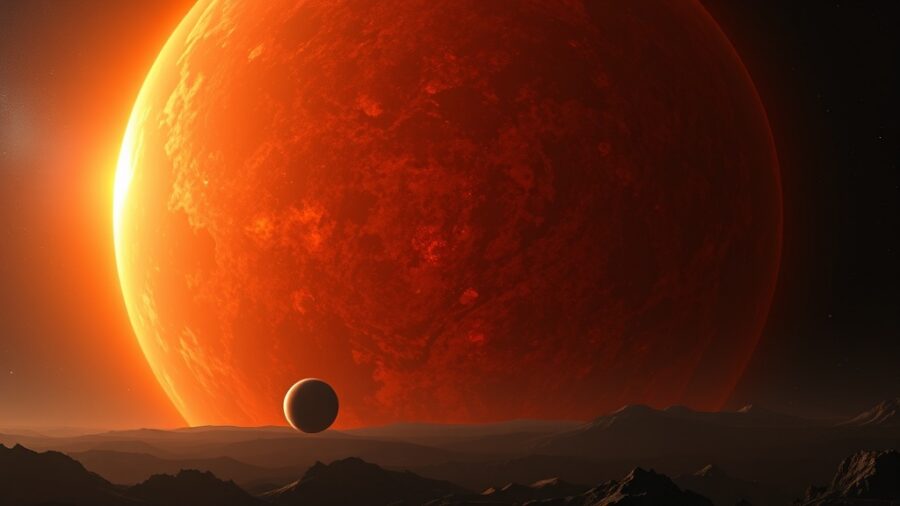
Red giant stars exhibit unique physical characteristics that set them apart from other stellar types. They possess a remarkable increase in size, becoming up to 100 times larger than their initial main sequence size. Additionally, their surface temperature decreases, leading to a reddish hue, which is a defining feature of this phase. The luminosity of red giants also increases significantly, making them some of the brightest stars in the night sky.
For example, Betelgeuse, a well-known red giant located in the Orion constellation, has a radius approximately 1,000 times that of the Sun and shines with a luminosity around 100,000 times greater. Such examples illustrate the immense scale and brightness of red giant stars.
Behavior and Composition
The internal structure of red giants is also markedly different from that of smaller stars. As hydrogen in the core is depleted, the core contracts, leading to increased temperatures that ignite helium fusion. This process results in a layered structure where helium burns in a shell surrounding the core. The atmosphere expands, creating a vast envelope that can become unstable, leading to phenomena such as pulsation and mass loss.
The Process of Expansion
Hydrogen Shell Burning
As stars transition into the red giant phase, the core undergoes significant changes. When hydrogen is depleted, the core contracts under gravity, causing temperatures to rise. This increase initiates hydrogen shell burning around the core, which generates additional energy and leads to the star’s expansion. The outer layers swell, transforming the star into a red giant.
The expansion process can be understood through the principles of thermodynamics and nuclear fusion. As the core temperature rises to approximately 100 million Kelvin, helium fusion begins, leading to the production of carbon and oxygen. This process marks a significant milestone in the star’s life cycle.
Instabilities and Pulsations
The outer layers of red giants can experience instabilities that lead to pulsations. These pulsations are caused by changes in pressure and temperature within the star, resulting in cycles of expansion and contraction. Such behavior can be observed in stars like Mira, a red giant known for its variability in brightness. Understanding these pulsations provides insights into stellar structure and evolution.
The Role of Helium Fusion
Beginning of Helium Burning
Helium fusion is a critical process in the life of red giant stars. Once core temperatures reach sufficient levels, helium begins to fuse into heavier elements through the triple-alpha process. This reaction occurs when three helium nuclei combine to form carbon, and it is a fundamental aspect of stellar nucleosynthesis.
During this phase, stars may experience a brief period of stability, known as the horizontal branch phase, where they burn helium steadily. This phase can last for millions of years, enabling the star to maintain a stable luminosity. The production of carbon and oxygen during helium fusion contributes to the chemical enrichment of the universe.
Impact on Stellar Evolution
The onset of helium fusion has significant implications for a star’s evolution. As helium is consumed, the core continues to contract, leading to higher temperatures that can ignite further fusion processes, such as carbon burning. This escalation of fusion reactions can lead to dramatic changes in a star’s structure and energy output, influencing its ultimate fate.
Comparative Analysis of Star Types
Red Giants vs. Other Stellar Types
Red giants are part of a broader classification of stars, each with distinct characteristics based on mass and evolutionary path. They differ significantly from main sequence stars and white dwarfs. For instance, while main sequence stars primarily fuse hydrogen, red giants have transitioned to helium fusion, marking a pivotal point in their lifecycle.
| Star Type | Mass Range | Key Characteristics |
|---|---|---|
| Main Sequence | 0.08 – 100 solar masses | Hydrogen fusion, stable brightness |
| Red Giant | 0.5 – 10 solar masses | Helium fusion, expanded size, reddish hue |
| White Dwarf | Up to 1.4 solar masses | End stage, no fusion, cooling down |
Variability Among Red Giants
Not all red giants are created equal; they can be further classified into two main categories: normal red giants and luminous red giants. Normal red giants exhibit moderate luminosity, whereas luminous red giants are among the most massive stars in the universe, often exceeding 10 solar masses. The differences in mass and composition lead to variations in their physical properties, lifespans, and fates.
The Fate of Red Giant Stars
Possible End States
The fate of a red giant star is largely determined by its mass. For less massive stars, the end of the red giant phase typically results in the shedding of outer layers, forming a planetary nebula, while the core remains as a white dwarf. This process contributes to the recycling of materials in the universe, enriching the interstellar medium.
In contrast, more massive red giants may undergo a supernova explosion, leading to the formation of a neutron star or black hole. The violent death of these stars plays a crucial role in dispersing heavy elements throughout the cosmos, paving the way for the formation of new stars and planets.
Significance in Cosmic Evolution
The evolution and eventual demise of red giant stars are vital to understanding cosmic evolution. They serve as factories for heavy elements, which are essential for the development of planets and life as we know it. Furthermore, the supernovae resulting from massive red giants contribute to the dynamic processes that shape galaxies and the universe’s structure.
Conclusion and Summary
The red giant star phase is a pivotal and visually captivating stage in the life cycle of stars. Understanding this phase sheds light on the fundamental processes of stellar evolution, from hydrogen burning to helium fusion and beyond. Red giants play a crucial role in the universe, acting as powerful sources of energy and elements that contribute to galactic evolution.
As we have explored, the characteristics, processes, and eventual fates of red giants illustrate their importance in the grand tapestry of cosmic history. These stars, with their dramatic transformations and significant contributions to the universe, remind us of the intricate connections between stellar life cycles and the elements that form the building blocks of life.
FAQs about Red Giant Stars
What is a red giant star?
A red giant star is a late-stage star characterized by its large size and reddish hue. This phase occurs after a star has exhausted hydrogen in its core and has started to fuse helium.
How do red giants form?
Red giants form when a star depletes the hydrogen fuel in its core, causing it to contract and heat up, which leads to the expansion of its outer layers. This process marks a transition from the main sequence phase.
What is the lifespan of a red giant star?
The lifespan of a red giant star varies depending on its mass. Generally, red giants can last anywhere from a few million to several billion years before reaching the end of their evolutionary stage.
What happens to red giant stars when they die?
When red giant stars die, their fate depends on their mass. Less massive stars shed their outer layers, creating planetary nebulae, while more massive stars may explode in supernovae, leaving behind neutron stars or black holes.
How do red giants contribute to the universe?
Red giants contribute to the universe by producing heavy elements through nucleosynthesis and dispersing them into the interstellar medium during their death throes. This process enriches the material available for future star and planet formation.
Recap
- The red giant star phase is a crucial stage in stellar evolution.
- Stars transition to red giants after exhausting hydrogen in their cores.
- Helium fusion plays a significant role in the evolution of red giants.
- Red giants can vary in size and luminosity based on their mass.
- The fate of red giants differs; they may end as white dwarfs or explode as supernovae.
- Red giants are essential for enriching the universe with heavy elements.
- Understanding red giants helps us comprehend the lifecycle of stars and cosmic evolution.
- The study of red giants continues to provide insights into the structure of galaxies and the universe.