
Anúncios
Introduction to Studying Distant Moons
The exploration of distant moons—those orbiting planets far beyond our Earthly neighborhood—has always captured the imagination of scientists and the public alike. With advances in technology and space exploration, we are now closer than ever to understanding these remote natural satellites. The study of distant moons provides a window into the past, revealing important clues about the formation and evolution of our solar system. They hold keys to broader questions about planetary science, including potential for habitability and existence of extraterrestrial life, which ignite the interest of cosmologists and geologists worldwide.
Distant moons are often locked in eternal orbits around their parent planets, and their surfaces tell the complex story of their environmental and geological past. By studying moon surfaces, scientists hope to better understand not only the moons themselves but also their interactions with their primary planets. This knowledge can provide insight into the processes shaping our solar system and potentially those around other stars. Through sophisticated techniques and instruments, mankind has begun to peel back the layers of mystery enveloping these celestial bodies.
Anúncios
Why Studying Moon Surfaces Is Important for Science
The surfaces of distant moons hold invaluable data, enabling us to decode the conditions under which these bodies formed and how they have changed over time. From crater impacts to volcanic activity and ice flows, each feature on a moon’s surface tells a story of dynamic processes at work. These processes can offer a glimpse into the past of the solar system, providing a timeline of events that shaped planetary bodies.
Additionally, some moons are thought to house subsurface oceans beneath icy crusts, raising the possibility of supporting life. Understanding the surface composition and geological activity of these moons can yield clues about their potential habitability. For example, the plumes of water vapor venting from the surface of Europa, a moon of Jupiter, have stirred interest in the search for life beyond Earth. Studying the surface could help us determine the chemistry and dynamics sustaining such potential habitats.
Research into moon surfaces also sheds light on comparative planetology. By comparing the geological and atmospheric characteristics of moons within our solar system, scientists can develop models to understand planets and moons elsewhere in the universe. This comparative approach enriches our comprehension of how celestial bodies evolve and behave in various environments.
Key Tools Used in Lunar Surface Exploration
To study distant moons effectively, scientists employ an array of specialized tools and technologies. Some of the key instruments currently used include telescopes, space probes, and landers, each providing unique advantages in gathering vital data from these remote surfaces.
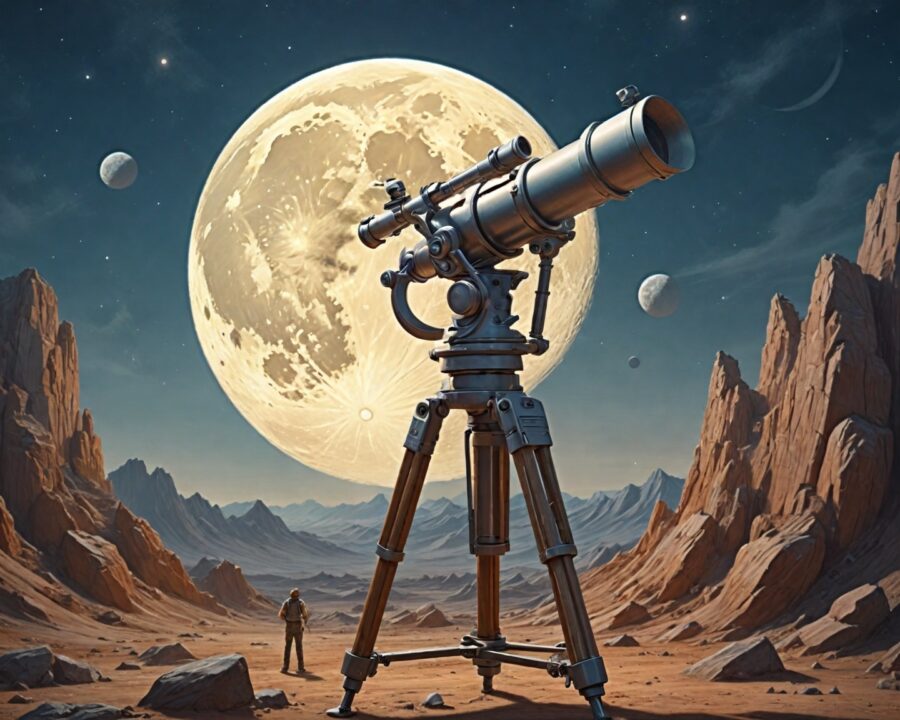
Telescopes, particularly those stationed in space like the Hubble Space Telescope, offer an unobstructed view of far-off celestial bodies. Equipped with advanced imaging capabilities, they can capture detailed images and spectra from moons located at colossal distances. Due to their position beyond Earth’s atmosphere, space telescopes can glean data without atmospheric interference, capturing images that reveal the moons’ surface features in greater detail.
Space probes have arguably transformed our understanding of the solar system’s moons. These robotic emissaries can travel vast distances, taking measurements and capturing images that are impossible from Earth alone. Launched decades ago, missions such as Pioneer and Voyager provided unprecedented views of the moons around Jupiter and Saturn. Advanced models like ESA’s JUICE and NASA’s Europa Clipper continue the legacy, equipped with refined instruments capable of mapping surfaces, detecting subsurface oceans, and analyzing atmospheric composition.
Lastly, landers represent a significant evolution in surface exploration as they touch down directly onto the surface of moons. By deploying scientific equipment on-site, landers such as those used in the Chang’e series for Earth’s Moon provide crucial data on the texture, composition, and mechanical properties of the lunar surface. In the future, landers will be crucial to exploring and analyzing the surfaces of distant moons, offering the potential for direct interaction and experimentation.
Role of Space Probes and Landers in Surface Analysis
Space probes play an integral role in the exploration of distant moon surfaces. As remotely operated vehicles, they provide a bridge between Earth and these distant realms, overcoming current limitations in human space travel. By entering the vicinity of a moon, probes can relay high-resolution images and data, overcoming the light delays and resolution limits encountered using Earth-based telescopes.
During the flybys of moons by the Galileo and Cassini missions, these space probes provided detailed images and data that transformed our knowledge of Jupiter’s and Saturn’s moon systems. By measuring the gravitational fields, magnetic environments, and surface compositions, probes give scientists critical insights into the moons’ interiors and atmospheres. Additionally, they conduct spectrometric analyses by capturing light in various wavelengths, extracting crucial information about the surface substances.
Landers, a more recent addition to moon exploration, enhance our understanding significantly by offering an on-the-ground perspective. Rather than simply flying by or orbiting, landers like the Huygens probe on Titan, Saturn’s largest moon, transmit data from the surface environment. They have the capability to drill, excavate, and perform chemical analyses on-site, delivering detailed observations of the moons’ geology and climate conditions. This on-hand data is vital, revealing the moons’ geological makeup and potential for sustaining life.
How Spectroscopy Helps Analyze Moon Surfaces
Spectroscopy is one of the primary tools used in analyzing the surfaces of distant moons. Through this method, scientists analyze the light emitted or reflected by substances to determine their chemical composition. By employing spectroscopy, researchers can dissect the light spectra from moons and gain insights into their surface materials without needing physical samples.
Several types of spectroscopy apply to moon surface exploration. Reflectance spectroscopy involves analyzing the sunlight reflected off the moon’s surface, indicating the minerals present by their specific spectral signatures. By capturing and studying these reflectance spectra, scientists can identify the compounds and categorize them, aiding the understanding of the moon’s geological history and surface processes.
Infrared spectroscopy is particularly useful for determining the icy and possible organic compositions on the surfaces of moons like Europa or Enceladus. By examining the infrared spectra, scientists can identify the presence of water ice, hydrates, or complex organic molecules, all of which may provide clues about habitability and subsurface environments.
Together with more specialized spectrometers, this approach helps decipher the thermal, compositional, and radiation properties of moon surfaces. These properties can reveal interactions with environmental factors, like solar radiation and cosmic influences, over time. Spectroscopy thereby plays a vital role in the broader field of distant moons exploration, enhancing our ability to understand these complex celestial bodies.
Using Radar and Imaging Technology for Surface Mapping
Radar and imaging technologies are integral to mapping the surfaces of distant moons. These technologies reveal details about the topography, surface roughness, and structural composition that are essential for understanding both surface features and underlying geophysical processes.
Radar, particularly synthetic aperture radar (SAR), is widely used to penetrate cloud-covered or icy surfaces of moons where optical imaging may be obstructed. SAR sends microwave pulses to the moon and measures the echo’s return time, constructing detailed images of the surface from these signals. This method is vital for studying moons like Titan, which is shrouded in a dense atmosphere that obstructs optical visibility. Radar data have been used to map Titan’s lakes and dunes, providing insight into both surface and subsurface features.
Advanced imaging systems, often equipped on space probes, allow preeminent assessments of moon surfaces. These systems include high-resolution cameras that capture detailed images, and some involve multispectral imaging to gather data across various wavelengths simultaneously. This enables researchers to distinguish different materials based on their spectral responses. Historical missions, like Cassini’s confusion over the smoothness of Enceladus’ surface or regions like Europa’s chaotic terrains, illustrate the role imaging technology plays in advancing our understanding.
Modern mapping techniques use data from multiple sources to create comprehensive surface models. These detailed maps help researchers infer geological processes, potential habitable zones, and changes in surface characteristics over time. Radar and imaging, therefore, provide critical tools for assembling a comprehensive picture of moon surfaces, both for current missions and future endeavors.
Challenges in Studying Distant Moon Surfaces
Studying the surfaces of distant moons presents several daunting challenges due to their vast distances, harsh conditions, resource limitations, and technological constraints. Overcoming these obstacles requires innovative solutions and is often the focus of ongoing research and development programs.
One significant challenge is the sheer distance between Earth and these moons, which introduces delays in communication and limits real-time interactions with probes and landers. This distance necessitates autonomous systems capable of conducting scientific operations independently once deployed. The light travel time can be as long as tens of minutes, impacting a probe’s ability to stream live information back to mission control, requiring pre-programmed instructions for crucial operations.
Distant environments also impose severe conditions that tested the durability of exploration technologies. Extreme temperatures, intense radiation, and low-pressure atmospheres require specifically engineered materials and systems able to withstand the harshness of space. Radiation-hardening technology and thermal insulation systems have been employed to ensure that instruments continue functioning in these hostile settings.
The limited availability of resources—especially power—on distant moons necessitates the development of efficient resource use strategies. Solar panels, nuclear generators, and battery systems provide power, but they must be optimized to maximize the energy captured and used. Additionally, maneuverability in space and within gravitational pulls of moons or parent planets demands precise propulsion systems to execute desired functions without risking collision or mission failure.
Notable Missions That Studied Moon Surfaces
Numerous space missions have significantly advanced our understanding of the surfaces of moons across our solar system. These missions represent remarkable achievements in engineering, scientific exploration, and international collaboration, conducting detailed observations and analyses of some of the most challenging terrains humanity has ever explored.
The Galileo mission to Jupiter revolutionized our comprehension of the Jovian moons, particularly Europa, Ganymede, and Callisto. With detailed flybys synergized with on-board scientific instruments, Galileo provided unprecedented high-resolution images and valuable data on the presence of subsurface oceans, impacting future exploration strategies for potentially habitable environments.
Another landmark mission, Cassini-Huygens, focused on Saturn and its enigmatic moon Titan. Cassini orbited Saturn, while Huygens landed on Titan, providing the first-ever imagery from its surface. This mission shed light on Titan’s dense atmosphere and hydrocarbon lakes, opening new research directions in astrobiology and comparative planetology.
More recently, the Lunar Reconnaissance Orbiter (LRO) demonstrated that even Earth’s Moon still holds secrets waiting to be uncovered. The LRO satellite has mapped the Moon in unprecedented detail, providing crucial data for future lunar landings and potential human missions. It continues to reveal aspects of the Moon’s surface that facilitate new hypotheses about lunar evolution and geology.
Future Technologies for Exploring Distant Moons
The future of distant moons exploration hinges upon innovative technological developments enabling more detailed and sophisticated study of these cosmic neighbors. As we continue to prepare for these endeavors, several pivotal technologies are envisioned to enhance the efficiency and scope of exploration activities.
Advanced robotics will undoubtedly play a vital role in the exploration landscape. Designing highly autonomous robots equipped with AI capabilities will empower space missions to analyze moon surfaces more effectively. These robots are expected to harness machine learning algorithms for real-time decision-making, effectively navigating complex terrains and conducting in-situ analyses independently.
Another exciting frontier lies in the use of miniaturized instruments and modules known as CubeSats. These small, versatile satellites can accompany larger missions, offering the potential to conduct parallel observations or target specific phenomena of interest. CubeSats can complement traditional instrumentation by executing focused experiments at reduced cost and risk.
In addition, novel propulsion systems, such as ion and plasma-based technologies, promise more efficient travel through space, reducing time and increasing payload capacity between Earth and far-flung moons. The development of higher-efficiency energy sources, including compact nuclear reactors, will provide sustained power for long-duration missions, ensuring that spacecraft can perform more prolonged and comprehensive explorations.
Practical Applications of Moon Surface Research
Research into the surfaces of distant moons offers a wide array of practical applications that extend beyond science, impacting areas such as technology, resource acquisition, and space policy. The insights gained contribute to innovations and improvements in various sectors.
In technology, the challenges associated with deep-space missions drive advancements that translate to Earth-based applications. Radiation shielding, thermal insulation, and autonomous navigation systems initially designed for moon missions find parallels in medical imaging, material science, and industry-grade robotics. Such dual-purpose technology development encourages private sector collaboration and investment.
Resource acquisition presents another promising application avenue. Moons with abundant water ice or other valuable minerals might be harnessed for future in-situ resource utilization (ISRU). This could benefit long-term space missions by providing fuel, oxygen, and construction materials, reducing the need for Earth-based supply logistics, and lowering mission costs.
Moreover, moon surface research fosters international cooperation and serves as a catalyst for formulating space policy and regulations. Collaborating in space exploration necessitates agreements on shared knowledge and technological development, enhancing global diplomacy and promoting peaceful uses of outer space. These shared goals reinforce humanity’s collective commitment to unlocking the secrets beyond our world.
FAQ
What methods are used to study distant moons?
Various methods are employed to study distant moons, including space telescopes, probes, landers, spectroscopy, radar, and imaging technology. Each offers distinct advantages and complements others for comprehensive data collection.
Why is studying the surfaces of moons important?
Studying moon surfaces is crucial for understanding geological history, identifying potential habitats, comparing celestial bodies, and gaining insights into planetary formation processes across the solar system.
How do space probes aid in moon surface exploration?
Space probes approach within close proximity to moons, gathering high-resolution images, measuring gravitational fields, analyzing surface compositions, and conducting spectrometric analyses to unravel the characteristics of these distant realms.
What role does spectroscopy play in moon studies?
Spectroscopy analyzes the light spectrum reflected from moons’ surfaces to determine their chemical composition, offering insights into their material properties, thermal behavior, and potential for sustaining life.
What are the challenges of exploring distant moons?
Challenges include vast distances, delays in communication, hostile environmental conditions, and limited available resources, all requiring advanced technological solutions and novel strategies for successful exploration.
Which missions have notably advanced moon exploration?
Key missions include Galileo to Jupiter, Cassini-Huygens to Saturn, and the Lunar Reconnaissance Orbiter to Earth’s Moon, each providing valuable data revolutionizing our understanding of moon surfaces.
What future technologies are anticipated for moon exploration?
Future technologies involve autonomous robotic systems, CubeSats, advanced propulsion, and high-efficiency energy sources, spearheading more efficient and comprehensive future explorations of distant moons.
How does moon surface research benefit Earth?
Practical benefits include technology advancements, resource acquisition opportunities, and international cooperation, impacting science, industry, and space policy while promoting peaceful space exploration.
Recap
In this article, we explored the significance of distant moon surface study, the critical tools and methods for exploring these remote celestial bodies, and the pivotal role missions like Galileo and Cassini have played in transforming our knowledge. We also examined future technologies and practical benefits arising from moon exploration, highlighting advancements in robotics, CubeSats, and international collaboration. The challenges faced in this field necessitate ongoing innovation, fostering exciting new opportunities and applications both within and beyond our solar system.
Conclusion
Exploring the surfaces of distant moons offers a journey deep into the heart of the solar system, unraveling the mysteries held by these intriguing celestial bodies. The endeavor not only enhances our scientific understanding but also spurs technological progress, thereby influencing various facets of life on Earth. From the intricate dance of space probes in the void to the remarkable insights gleaned from spectroscopic data, each step forward unlocks more of the universe’s secrets.
As nations and organizations pool their resources and knowledge in pursuit of exploration, the resulting discoveries promise to deepen our appreciation of the cosmos. Our continued curiosity and innovation ensure that moons’ surfaces not only provide answers about their origins but also inspire dreams yet to be realized, affirming our place in the ever-expanding tapestry of the universe.