
Anúncios
Introduction to Studying Distant Moons
In the vast expanse of our solar system, moons orbiting distant planets offer a wealth of scientific information just waiting to be discovered. These celestial bodies harbor unique characteristics, from icy surfaces hiding subsurface oceans to volcanic activity that can reshape entire landscapes. The study of these distant moons opens a window not only into the moons themselves but also into the formative processes of planets and atmospheres. As scientists venture to these worlds, they utilize cutting-edge space exploration techniques to unravel the mysteries locked within these distant lands, and in doing so, expand our understanding of the universe.
Exploring the surfaces of these moons presents a fascinating challenge for scientists. Unlike planets, which often have substantial atmospheres and larger sizes allowing for more straightforward analysis, moons offer different conditions needing specialized investigation methods. The need to develop and refine these methods has catalyzed significant advancements in space technology. In this article, we will delve into the various tools and technologies used to study the surfaces of distant moons, the importance of these studies, and how new advancements will shape the future of moon exploration.
Anúncios
Why Studying Moon Surfaces is Important
The study of moon surfaces offers crucial insights into not only the moons themselves but also the history and evolution of our solar system. Surface features such as craters, canyons, and plains bear witness to geological processes over billions of years. By understanding these features, scientists can piece together events from the distant past, such as asteroid impacts and volcanic eruptions, which shaped these worlds.
Moreover, some moons, like Europa and Enceladus, harbor indications of subsurface oceans under their icy exterior. These environments could potentially support life, making these moons significant targets for astrobiological studies. By studying their surfaces and the organic molecules that may emerge from beneath, scientists hope to find biosignatures or other evidence of life beyond Earth.
In addition, these moons serve as analogs for understanding exoplanets—planets orbiting stars outside our solar system. The dynamic processes ongoing in our own planetary backyard can provide vital clues about similar processes that might occur on other worlds, thereby enhancing our comprehension of where life might exist in the universe.
Key Tools Used in Moon Surface Exploration
One of the primary tools in moon surface exploration is spectroscopy. Scientists use spectrometers to analyze the light reflected or emitted from a moon’s surface to determine its composition. By examining spectral lines, researchers can identify the presence of specific elements and compounds, helping to map the lunar landscape’s chemical makeup.
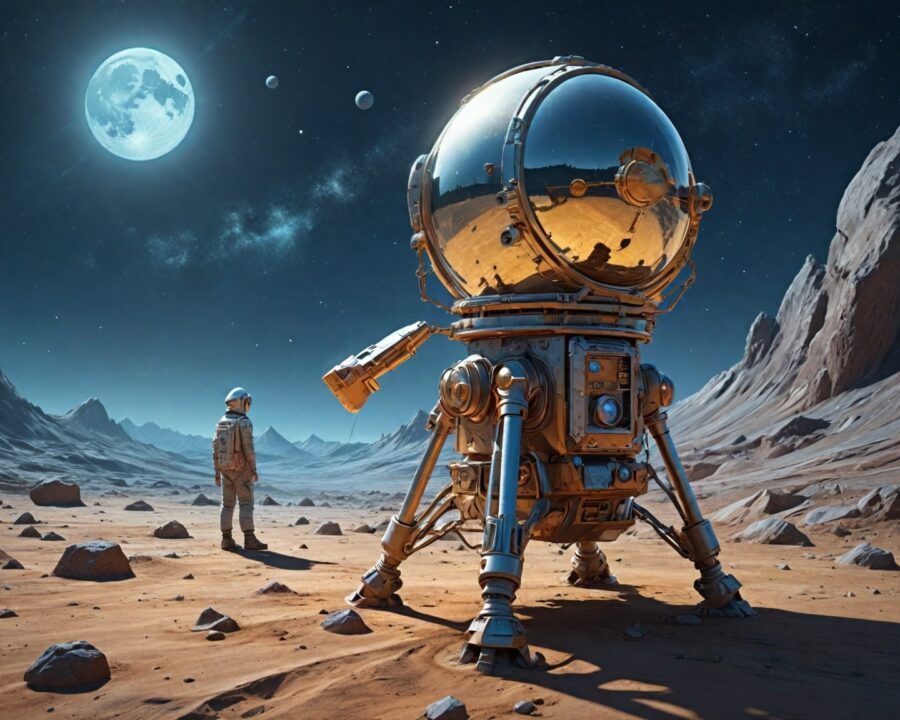
Rover technology, a staple in planetary exploration, has been adapted for moons as well. These robotic explorers carry a suite of instruments designed to traverse the rugged terrain, collect samples, and perform in-situ analysis. Equipped with cameras, spectrometers, and sampling tools, rovers can provide invaluable data directly from the moon’s surface, offering unprecedented detail.
Seismometers are another key tool in understanding moons. While typically associated with studying planets, these instruments help measure ‘moonquakes’ that can reveal information about a moon’s internal structure. By analyzing seismic activity, scientists can infer the presence of liquid layers beneath icy crusts or the extent of tectonic activity, offering a glimpse into the moon’s geophysical state.
Role of Space Probes and Landers in Data Collection
Space probes and landers are at the forefront of collecting data from distant moons. Their ability to travel vast distances and reach hard-to-access locations makes them invaluable in space exploration. These spacecraft are designed to be robust and versatile, equipped with a myriad of scientific instruments tailored for specific objectives.
Probes like NASA’s Galileo and Juno missions to Jupiter have provided detailed images and data of the planet’s moons, capturing everything from volcanic eruptions on Io to the icy crust of Europa. These missions are pivotal as they offer a broad overview of the moons, allowing scientists to identify areas of interest for further study.
Landers, on the other hand, enable a more intimate exploration of a moon’s surface. Unlike flyby probes, landers can establish contact with the surface to conduct experiments over an extended period. They can drill below the surface to collect samples from underneath and monitor atmospheric conditions, providing a continuous stream of data back to Earth.
How Remote Sensing Helps Analyze Moon Surfaces
Remote sensing is a cornerstone of modern space exploration, allowing scientists to observe and analyze distant moons without direct contact. Satellite and space probe-based sensors capture data in various wavelengths, including visible, infrared, and ultraviolet. This multi-spectral analysis helps in identifying surface and subsurface compositions.
One of the most significant advantages of remote sensing is the ability to conduct global surveys within a short time frame. Instruments like imaging spectrometers can orbit a moon and build extensive maps detailing mineral and elemental compositions across its surface. These maps can then be compared over time to detect changes or dynamic processes like melting ice or shifting tectonic plates.
Thermal imaging is another aspect of remote sensing that plays a crucial role. It helps in detecting heat anomalies on a moon’s surface, which might indicate geothermal activity. For instance, observing warm spots on a moon’s icy crust could point to the outgassing of warmer subsurface fluids, suggesting the presence of subsurface oceans.
Challenges in Studying Distant Moons
Exploring distant moons presents unique challenges due to their remote locations and harsh environments. One of the primary hurdles is communication delay. For missions targeting moons millions of miles away, communication signals can take hours to travel, limiting real-time command and control of spacecraft.
Harsh environmental conditions such as extreme temperatures, radiation, and rugged terrains add complexity to the design and operation of spacecraft. Ensuring these exploratory tools function correctly and are equipped to handle such environments is a critical engineering challenge. Instruments must be shielded from radiation and capable of operating in severe temperatures to gather reliable data.
Additionally, limited resources play a significant role in space exploration missions. Budget constraints can affect the types and number of missions deployed to study these locations. As such, scientific teams must maximize the efficiency and output of each mission, carefully prioritizing objectives to ensure meaningful data collection.
Examples of Successful Moon Surface Studies
There have been several successful missions that have greatly enhanced our understanding of moon surfaces. The Huygens probe, part of the Cassini–Huygens mission, is a prime example. It landed on Saturn’s moon Titan in 2005, sending back detailed images and data about Titan’s surface and atmosphere, revealing lakes and seas of liquid methane and ethane.
NASA’s Lunar Reconnaissance Orbiter (LRO) has been instrumental in mapping the Moon’s surface. Equipped with high-resolution cameras, it has documented lunar terrain in unprecedented detail, identifying landing sites and geological features crucial for future manned missions.
The Voyager missions, though primarily aimed at studying the outer planets, provided valuable flyby images of moons such as Io, Europa, and Ganymede. These images revealed active volcanoes, complex ice-covered surfaces, and potential oceanic environments, laying the groundwork for subsequent missions like the Galileo probe.
Future Technologies for Moon Exploration
Emerging technologies promise to revolutionize how scientists study distant moons. The development of more sophisticated landers and rovers with AI capabilities will allow for more autonomous and nuanced exploration. These advancements could enable spacecraft to make real-time decisions, optimizing data gathering in challenging environments.
Miniaturization of scientific instruments is another exciting development. Compact and lighter instruments allow missions to include multiple scientific tools without increasing payload weight significantly. These efforts make it feasible to conduct comprehensive studies in a single mission.
Furthermore, advances in propulsion technology, like the development of ion and nuclear thermal propulsion, aim to make travel to distant moons faster and more efficient. Reduced travel times and increased payload capacities expand the potential for more frequent and extensive lunar exploration missions.
Common Questions about Moon Surface Research
What is the most studied moon in our solar system?
Io and Europa, moons of Jupiter, are among the most studied due to their geological activity and potential for harboring life beneath their icy crusts.
How do scientists determine the composition of a moon’s surface?
Spectroscopy is primarily used to determine surface composition by analyzing the reflected light’s wavelengths to identify materials present.
Can robots explore moon surfaces autonomously?
Yes, advancements in AI and robotics now permit robots to operate autonomously, performing tasks such as navigation and sample collection without direct human intervention.
What risks do space missions to moons face?
Missions face risks such as harsh environmental conditions, communication delays, technical malfunctions, and limited power supply due to distance from the Sun.
Why are some moons considered candidates for life?
Moons like Europa and Enceladus are considered candidates for life due to their subsurface oceans, which may provide the necessary conditions for life as we know it.
What role do international collaborations play in moon exploration?
Collaboration allows sharing of resources, expertise, and data, enabling more extensive and comprehensive exploration missions than any single entity could achieve.
How often are new moons discovered or studied?
New moons are discovered occasionally with advancements in telescope technology, while existing moons are continually studied with each new space mission.
How to Stay Updated on Moon Exploration Advancements
Staying informed about the latest advancements in moon exploration can be achieved through various means. First, following space agencies such as NASA and ESA on their official channels provides updates on ongoing and upcoming missions. These agencies often publish press releases and scientific papers that detail mission progress and findings.
Scientific journals and publications such as Science, Nature, and the Journal of Geophysical Research regularly feature articles on new discoveries and technological advancements in lunar and planetary science. Subscribing to these journals can provide in-depth insights and expert perspectives.
Additionally, attending conferences and symposiums focused on space exploration can be incredibly informative. Events such as the Lunar and Planetary Science Conference bring together leading experts to discuss the latest research, offering a collaborative environment to learn about ongoing studies and future projects.
Recap
Studying the surfaces of distant moons is a complex endeavor that requires sophisticated technology and methodologies. From remote sensing and spectrometry to deploying space probes and landers, a multitude of strategies are used to explore these celestial bodies. Understanding moon surfaces enhances our knowledge of the solar system’s evolution, potentially uncovers signs of extraterrestrial life, and serves as a stepping stone for future scientific advancements. Despite the numerous challenges faced, successful missions have already provided valuable insights, paving the way for future exploration with advanced technologies and international collaboration.
Conclusion
The exploration of distant moons stands at the frontier of human curiosity and scientific endeavor. As we gaze outward, these moons continue to intrigue us with the promise of discoveries ranging from geological wonders to potential habitats for life. The insights gleaned from studying their surfaces not only deepen our understanding of the cosmos but also inspire generations of scientists to push the boundaries of what is known and what is possible.
In the coming years, the advancement in space exploration techniques will undoubtedly enhance our capability to study these enigmatic worlds. As missions become more ambitious, the potential for groundbreaking discoveries will grow, offering a richer comprehension not only of our solar neighborhood but of the universe at large.