
Anúncios
Introduction to Saturn’s Rings
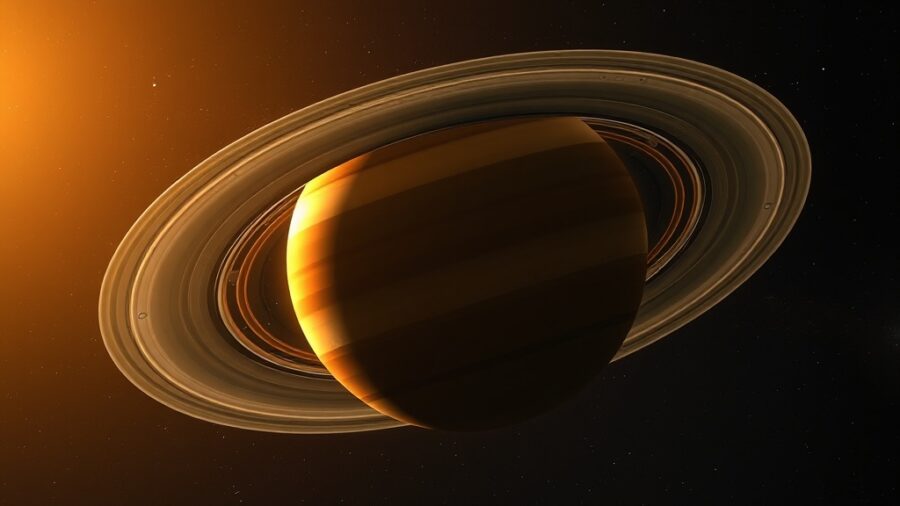
Saturn’s rings are one of the most magnificent and intriguing features of our solar system. Their stunning appearance, coupled with their complex structure, has captured the attention of astronomers and space enthusiasts alike. In this comprehensive exploration of the saturn rings composition origin, we will delve into the fascinating attributes that make these rings unique.
The rings of Saturn are not merely a spectacular visual phenomenon; they are also a subject of extensive scientific research. Understanding the composition and origin of Saturn’s rings offers insights into the formation of not just Saturn, but also other celestial bodies in our universe. This article promises to uncover the mysteries behind the rings, their significance, and the scientific endeavors aimed at studying them.
Anúncios
As we embark on this journey, readers will learn about the intricate details of what Saturn’s rings are made of, the theories surrounding their origins, and the ongoing research that continues to unveil new information. By the end of this article, you will have a thorough understanding of why Saturn’s rings are so significant in the field of planetary science.
Composition of Saturn’s Rings
The composition of Saturn’s rings is a remarkable aspect that contributes to their beauty and scientific interest. The rings are primarily composed of billions of ice particles, along with smaller amounts of rocky debris and dust. The varying sizes of these particles range from tiny grains to large boulders measuring several meters across.
Ice and Dust Particles
The predominant component of Saturn’s rings is water ice, which constitutes about 90% of their mass. This ice is believed to be the result of the disintegration of comets and icy moons that ventured too close to Saturn. The remaining 10% consists of silicate rock and other materials, which contribute to the rings’ diverse appearance.
Structure and Thickness
Saturn’s rings are not uniform; they are divided into several distinct rings, each with its own characteristics. The main rings are labeled A, B, and C, with the A ring being the outermost and the C ring the innermost. The thickness of these rings varies significantly, ranging from about 10 meters in some areas to several hundred meters in others. This unique layering creates striking visual patterns that can be observed from telescopes on Earth.
- A Ring: Contains gaps known as Cassini Division, which is about 4,800 kilometers wide.
- B Ring: The brightest and most massive ring, with an average width of about 25,500 kilometers.
- C Ring: Thinner and less dense, making it more difficult to observe.
Origin Theories of Saturn’s Rings
The origin of Saturn’s rings remains one of the most debated topics in planetary science. Various theories have been proposed to explain how these magnificent structures came to exist. Understanding these theories not only provides insight into Saturn’s history but also enhances our knowledge of planetary formation in general.
Destruction of Moons or Comets
One leading theory posits that Saturn’s rings formed from the remnants of a moon or comet that was torn apart by Saturn’s gravitational forces. This theory suggests that the gravitational pull was so intense that it shattered the celestial body into countless fragments, which then became the ring particles we observe today. This hypothesis is supported by the presence of smaller moons within the rings that may have contributed material.
The Age of the Rings
Another intriguing aspect of the rings’ origin is their age. While some researchers believe that Saturn’s rings formed relatively recently, within the last 100 million years, others argue that they could be as old as the planet itself, approximately 4.5 billion years. Determining the age of the rings is crucial in understanding the evolution of Saturn and the solar system as a whole.
| Theory | Description | Evidence |
|---|---|---|
| Destruction of Moons | Rings formed from a shattered moon or comet. | Presence of moonlets and gaps in the rings. |
| Recent Formation | Rings formed within the last 100 million years. | Dynamic processes observed in ring structure. |
| Ancient Origin | Rings have existed since the formation of Saturn. | Similarities to primordial solar system debris. |
Significance of Saturn’s Rings
The significance of Saturn’s rings extends far beyond their aesthetic appeal. They provide valuable insights into planetary science, astrophysics, and the processes that govern celestial bodies. Understanding the rings helps scientists to glean information about the conditions present in the early solar system.
Planetary Formation Insights
Studying Saturn’s rings can reveal important details about how planets and their systems evolve. The composition and structure of the rings offer clues regarding the materials and conditions that existed during the formation of Saturn and other gas giants. By examining the rings, scientists can draw parallels with the formation of planetary systems around other stars.
Effects on Saturn’s Moons
Saturn’s rings also play a crucial role in the dynamics of its moons. The gravitational interactions between the rings and the moons can lead to significant changes in their orbits and physical characteristics. This interplay is vital for understanding the evolution of both the rings and their surrounding moons, enhancing our knowledge of their geological histories.
Scientific Exploration of Saturn’s Rings
The exploration of Saturn’s rings has been a focal point for many space missions, contributing significantly to our understanding of these celestial structures. The most notable mission, NASA’s Cassini spacecraft, provided a wealth of data that has shaped current knowledge about the rings.
The Cassini Mission
Launched in 1997, the Cassini spacecraft arrived at Saturn in 2004 and conducted extensive studies of the planet and its rings until 2017. The mission yielded stunning images and valuable data, revealing intricate details of the rings’ composition, structure, and dynamics. Cassini’s findings challenged previous assumptions and opened new avenues of research.
Future Exploration Plans
Looking ahead, several future missions are being considered to continue the exploration of Saturn’s rings. These missions aim to build upon the discoveries made by Cassini and seek to answer unresolved questions regarding the rings’ origin, evolution, and their interactions with Saturn’s moons. Collaborative international efforts may lead to innovative spacecraft designs capable of conducting long-term studies of these magnificent structures.
- James Webb Space Telescope: Expected to provide detailed observations of the rings.
- Proposed Missions: Concepts for new missions are being discussed among space agencies.
- Advancements in Technology: New instruments will enhance the capabilities for studying distant celestial phenomena.
Future Research Directions
As our understanding of Saturn’s rings continues to evolve, future research will focus on several key areas. These include the detailed analysis of ring particle interactions, the study of the rings’ evolution over time, and the investigation of their potential for hosting unique environments.
Particle Interaction Studies
Research into how ring particles interact with each other and with Saturn’s moons is crucial for comprehending the dynamics of the rings. Understanding these interactions can shed light on the processes that govern the formation and maintenance of the rings. Advanced simulation models and observational data will play a key role in these studies.
Environmental Conditions
Investigating the environmental conditions within the rings is another promising area of research. Scientists are particularly interested in understanding whether the rings could harbor unique microenvironments or even life in some form. The chemical composition of the rings may provide clues about their potential habitability, opening up exciting possibilities for future exploration.
Conclusion
In summary, Saturn’s rings are not only a breathtaking visual spectacle but also a crucial element of planetary science. Their composition, origin theories, and significance provide a wealth of information about Saturn and the broader universe. Ongoing and future research will continue to unravel the mysteries surrounding these magnificent rings, enhancing our understanding of planetary formation and the dynamics of celestial bodies.
As we conclude this exploration, it is evident that the study of Saturn’s rings is an evolving field, ripe with opportunities for new discoveries. The insights gained from these rings will not only contribute to our knowledge of Saturn but will also inform our understanding of other planetary systems throughout the galaxy.
Frequently Asked Questions
What are Saturn’s rings made of?
Saturn’s rings are primarily composed of water ice, making up about 90% of their mass. The remaining 10% consists of rocky debris and dust particles, creating a diverse and dynamic structure.
How did Saturn’s rings form?
One prevailing theory suggests that Saturn’s rings formed from the remnants of a moon or comet that was torn apart by the planet’s gravitational forces. This process resulted in a vast array of ice and rock particles that make up the rings today.
Are Saturn’s rings new or ancient?
There is ongoing debate regarding the age of Saturn’s rings. Some researchers propose that they formed within the last 100 million years, while others argue they could be as old as Saturn itself, approximately 4.5 billion years.
What is the significance of Saturn’s rings in planetary science?
Saturn’s rings provide valuable insights into planetary formation, the dynamics of celestial bodies, and the conditions that existed in the early solar system. Studying the rings helps scientists understand the evolution of gas giants and their systems.
What future missions will explore Saturn’s rings?
Future missions, including those utilizing the James Webb Space Telescope and proposed new spacecraft, aim to continue exploring Saturn’s rings. These missions will seek to answer unresolved questions and enhance our understanding of these magnificent structures.
- Saturn’s rings are primarily composed of water ice.
- The origin theories include the destruction of moons and comets.
- Saturn’s rings provide insights into planetary formation.
- The Cassini mission significantly advanced our understanding of the rings.
- Future research will focus on particle interactions and environmental conditions.
- New explorations may reveal unique microenvironments within the rings.
- The age of Saturn’s rings is still a subject of scientific debate.
- Ongoing studies will continue to unveil the mysteries of Saturn’s rings.